

Violence Prevention Program Unit
Established in 2023, the Violence Prevention Program Unit funds and supports statewide efforts to prevent violence in New Mexico through four programs:
- Primary and Secondary Suicide Prevention
- Gun Violence prevention
- Sexual Violence Prevention
- Violence Prevention
Each program is led by a prevention expert who applies data-driven, research-based practices ground in the social ecological model and provides technical assistance to partners across the state.
The Violence Prevention Unit works in alignment with various state level coalitions including the New Mexico Coalition of Sexual Assault Programs (NMCSAP), New Mexico Coalition for Suicide Prevention and Awareness (NMCSPA), New Mexico Injury and Violence Prevention Coalition (NMIVPC) as well as the Center for Disease Control (CDC) to further our joint goals of a safer New Mexico for all.
Why is violence prevention important?
Violence and injury remain major public health issues in New Mexico. Suicide, firearm deaths, sexual violence, and community violence results in the loss of life, trauma, and long-term harm to individuals, families, and communities.
Data shows that violence disproportionately affects youth, women, LGBTQ+ individuals, people with disabilities, and historically marginalized communities,contributing to health inequities, economic strain, and disrupted education and employment.
Evidence from New Mexico and the CDC demonstrates that violence is preventable through coordinated, community-driven, and culturally responsive public health approaches that reduce risk factors, strengthen protective factors, and save lives.
By the numbers
Suicide Among New Mexican Adults
The data below is from the 2025 Behavioral Risk Factor Surveillance System - Health Behavior and Injury in New Mexico Final Report.
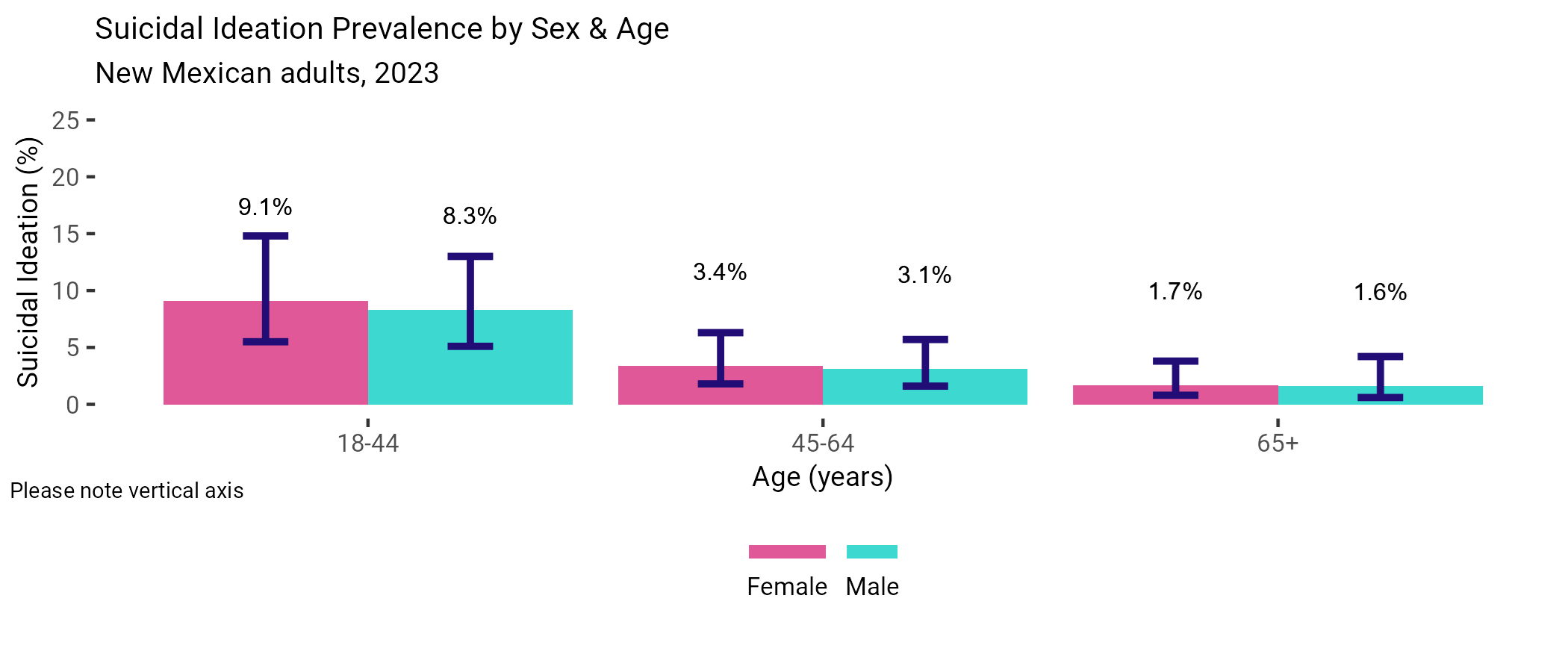
5.1% have seriously considered attempting suicide within the past 12 months. Those aged 18-44 have 1.5 times higher prevalence of suicidal ideation in the past 12 months than adults aged 45-64.
Lesbian, gay, bisexual or other sexual orientation adults have 4.1 times higher prevalence of suicidal ideation than heterosexual adults.
Those with an independent living disability have 7.7 times higher prevalence of suicidal ideation than adults without disability.
Overview
This image shows a graph for the survey results regarding suicidal ideation prevalence by sex and age for 2023. It shows that the age group 18-44 had a 9.1% for females and 8.3% for males. Ages 45-64 showed 3.4% for females and 3.1% for males. And ages 65+ had 1.7% for females and 1.6% for males.
Gun Violence Among New Mexican Adults
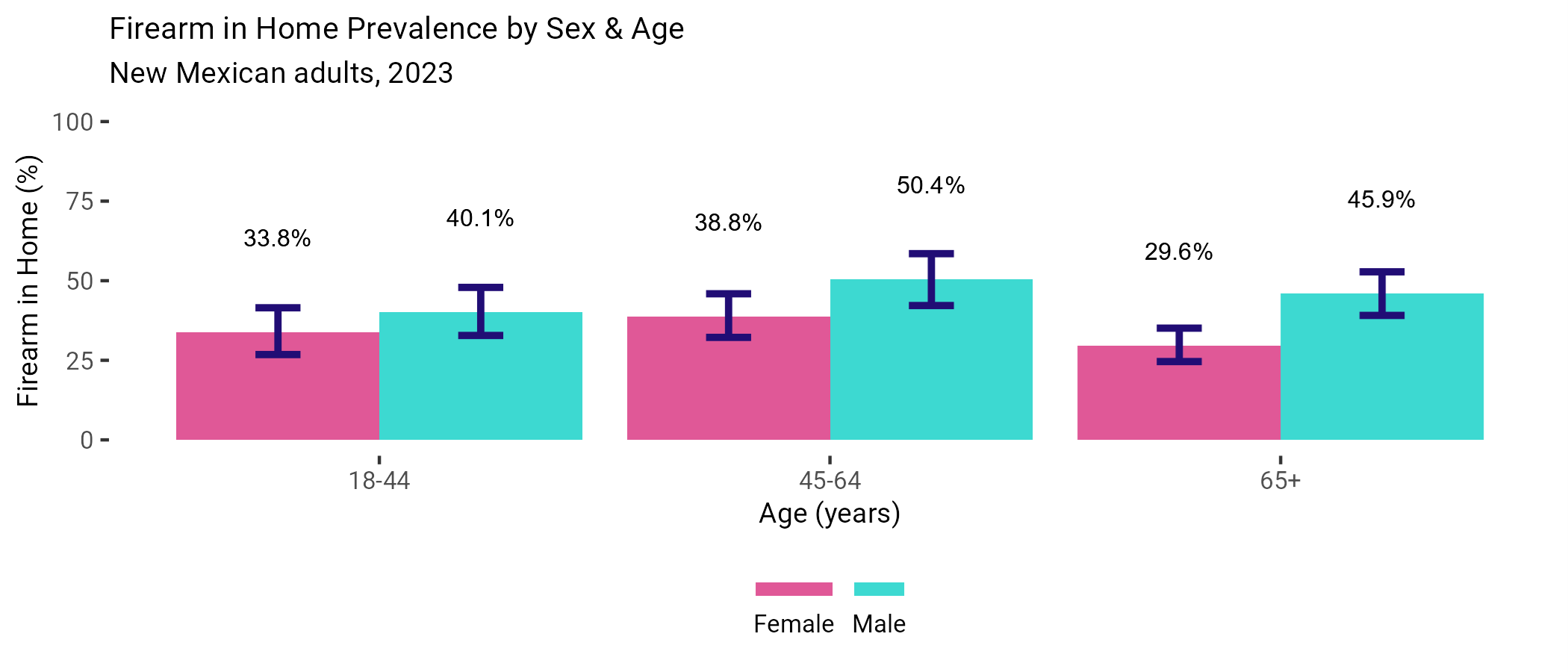
39.0% have at least one firearm in or around their home.
36.6% more households of White adults have firearms than households of Hispanic adults.
46.2% more households with an annual income of $75,000+ have a firearm than households with an income of $50,000-$74,999.
Households with an annual income of $75,000 are 3.4 times more likely than households with an annual income of less than $15,000 to have a firearm.
Overview
This image shows a graph for the survey results regarding firearm in home prevalence by sex and age for 2023. It shows that the age group 18-44 had a 33.8% for females and 40.1% for males. Ages 45-64 showed 38.8% for females and 50.4% for males. And ages 65+ had 29.6% for females and 45.9% for males.
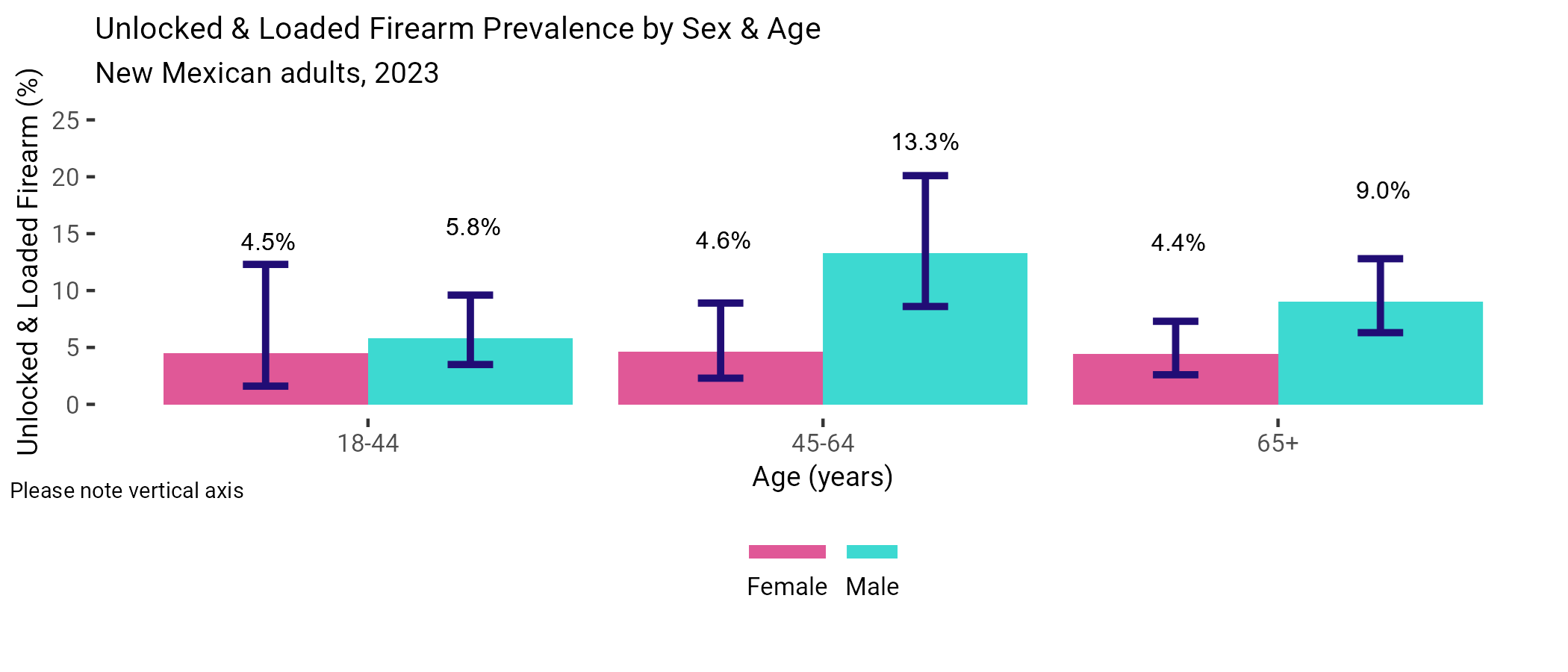
6.6% of NM households have at least one unlocked and loaded firearm.
5.5 times more households of heterosexual adults have unlocked and loaded firearms than households of lesbian, gay, bisexual or other sexual orientation adults.
Overview
This image shows a graph for the survey results regarding gun violence among New Mexican adults by sex and age for 2023. It shows that the age group 18-44 had a 4.5% for females and 5.8% for males. Ages 45-64 showed 4.6% for females and 13.3% for males. And ages 65+ had 4.4% for females and 9.0% for males.
Sexual Violence Among New Mexican Adults
15.9% have experienced unwanted sex or an attempt of unwanted sex.
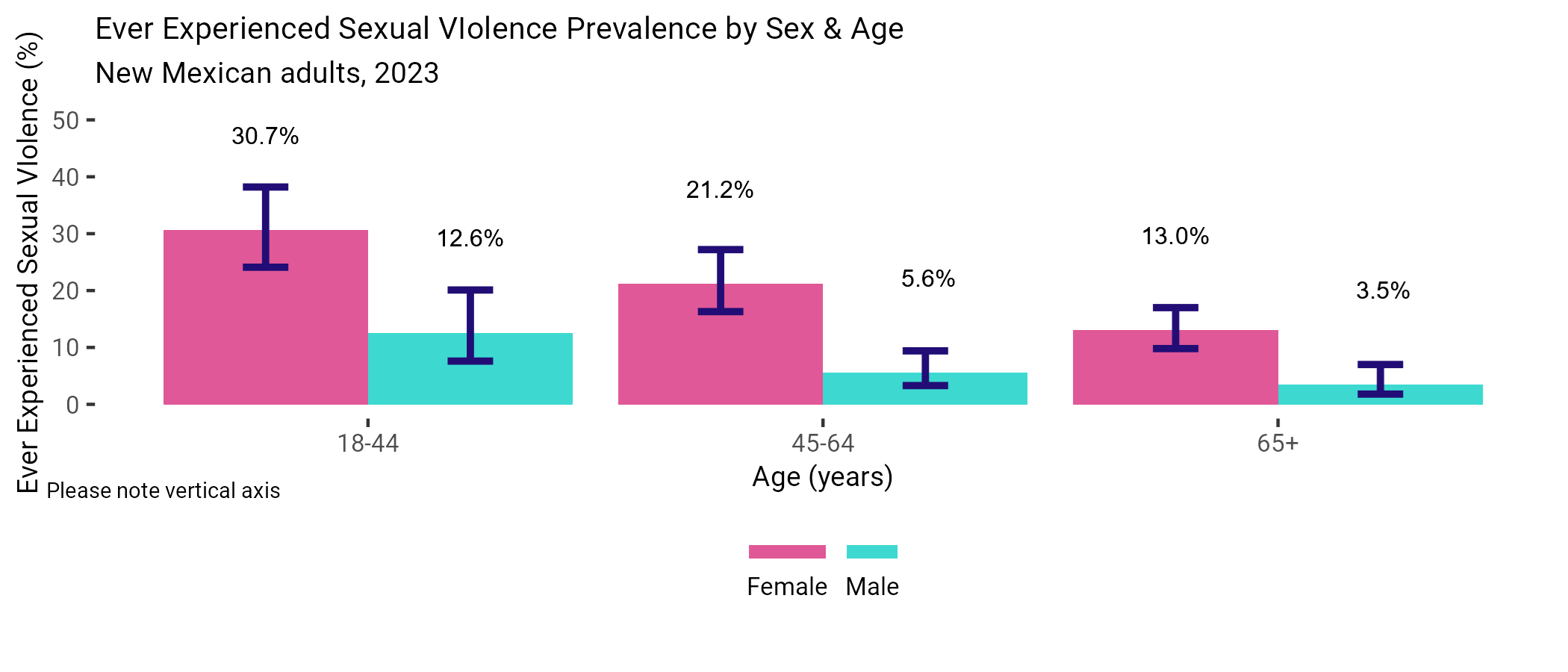
Females experience 2.8 times higher prevalence of sexual violence than males.
Adults who are lesbian, gay, bisexual, or another sexual orientation experience 1.1 times higher prevalence sexual violence than adults who are heterosexual.
Overview
This image shows a graph for the survey results regarding the experience of sexual violence prevalence by sex and age for 2023. It shows that the age group 18-44 had a 30.7% for females and 12.6% for males. Ages 45-64 showed 21.2% for females and 5.6% for males. And ages 65+ had 13.0% for females and 3.5% for males.
Survey Method
The New Mexico Behavioral Risk Factor Survey (BRFSS) is an annual, statewide telephone survey of New Mexico adults aged 18 years and older that is conducted through a collaborative effort between the Population Health Surveillance Branch PHSB of the CDC and NMDOH. New Mexico's BRFSS data contribute to the CDC Behavioral Risk Factor Surveillance System (BRFSS) that is conducted within every state, the District of Columbia, and several U.S. territories.
In 2023, the New Mexico BRFSS collected data from both landline and cell phone respondents. The sample of landline telephone numbers were selected using a list-assisted, random-digit- dialed methodology with a disproportionate stratification based on phone bank density, and whether the phone numbers were directly listed. The sample of cell phone numbers was randomly selected from dedicated cellular telephone banks sorted on the basis of area code and exchange. The sample phone numbers were provided to the Survey Section through CDC and their contractor.
Individuals who are 18 years of age or older, use a cell phone, or live in a private residential household with landline telephone service are eligible for the survey. Adults who do not have a cell phone for personal use and do not have access to a landline telephone are not eligible for the survey. Additionally, adults who live in nursing homes, group homes or institutions, such as prisons, are not eligible for the survey. The identity of the respondent is never known to the interviewer, and the last two digits of the phone number are never sent to the CDC. The CDC removes the remaining eight digits of the phone number from the data file after completing a quality assurance protocol. Participation in the survey is voluntary, and all individual information collected is confidential. Identifying information such as name, date of birth, or address, is not collected.
The CDC has developed a core set of questions that is included in the questionnaire of every state. The core has questions that are included annually and biennially. Optional modules of questions on a variety of topics have been developed by the CDC and made available to the states. States are free to include other questions that have been borrowed from other surveys or developed by the state. Such questions are referred to as 'state-added' questions.
Additional Information
The Violence Prevention Program Unit Manager participates in the Intimate Partner Violent Death review Team:
The New Mexico Intimate Partner Violence Death Review Team (IPVDRT), also known as the Domestic Violence Homicide Review Team, is a statutory body established by the New Mexico Legislature under NMSA §31-22-4.1 (Appendix A). The Team is funded by the New Mexico Crime Victims Reparation Commission (CVRC). Team coordination and staff services are housed at the New Mexico Statistical Analysis Center (NMSAC) within the Institute for Social Research, University of New Mexico. The Team is a multidisciplinary group of professionals who meet monthly to review the facts and circumstances surrounding intimate partner violence (IPV) or sexual assault (SA) related deaths in New Mexico, with the goal of reducing the incidence of these deaths statewide. The current 2025 report presents findings and recommendations from the Team's review of 26 partner violence-related deaths that occurred in 2021 or were solved by law enforcement in 2021.
Recent Activity
News Articles
Latest
- Rise in overdose deaths and ER visits in three Northeast counties (September 18, 2025)
- Collaborative effort presents “Golden Opportunity” to address opioid crisis in Albuquerque (October 15, 2024)
- Three out of five New Mexicans know someone with an opioid use disorder (August 30, 2024)
Popular
- Hydrocodone Combination Products Now DEA Schedule II Drugs (October 6, 2014)
- Overdose Deaths Decline in Nearly Two-Thirds of New Mexico’s 33 Counties (September 20, 2016)
- Opioid Prescribing Measures Show Improvement (October 11, 2018)
Health Data
Latest
- Opioid Epidemic: By the Numbers (Substance Use)
Publications
Featured
Latest
- Meeting Agenda for June 13, 2025 with Draft Minutes fromJanuary 10, 2025 (Meeting)
- Meeting Agenda for January, 10, 2025 with Draft Minutes from October 11, 2024 (Meeting)
- October 11, 2024 Meeting Minutes - Draft (Meeting)
Popular
- Legistlative Analysis and Public Policy Association- Fenanyl Test Strips (General)
- Guidelines for the Use of Benzodiazepines (Guide)
- Naloxone Statewide Standing Order for Schools in New Mexico (Policies, Protocols & Procedures)
Resources
Latest
- NMPathways
- Overdose Prevention and Pain Management Council Meeting Recording - October 11, 2024
- New Mexico Overdose Prevention and Pain Management Advisory Council Meeting 04/14/2023